Jul 6, 2026.
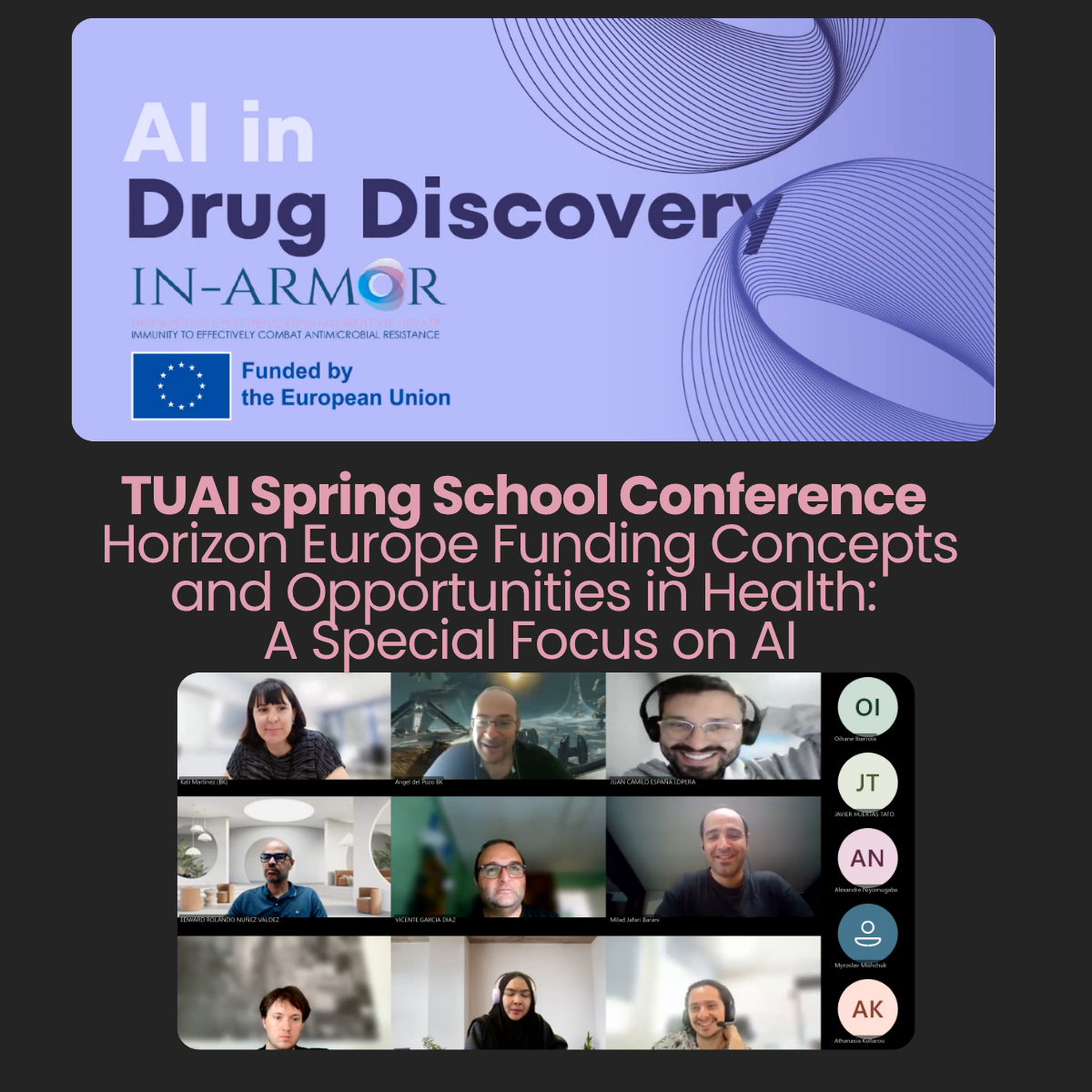
Earlier this week, our partner Biokeralty participated in the Spring School organised by the European project TUAI (Towards an Understanding of Artificial Intelligence via a Transparent, Open and Explainable Perspective). During the event, Biokeralty’s representatives showcased how the IN-ARMOR consortium is revolutionising drug discovery in the fight against antimicrobial resistance (AMR) through advanced computational methods.
The TUAI project, funded under the Marie Skłodowska-Curie Actions (MSCA) programme of Horizon Europe, aims to train a new generation of doctoral candidates specialising in Machine Learning and the design of sustainable, transparent Artificial Intelligence for application in industry, smart cities, and health. Biokeralty, which also participates as a strategic partner within the TUAI network, took advantage of this forum to deliver a prominent knowledge transfer session.
Speaking to a select audience of AI engineering doctoral researchers, Biokeralty delivered a presentation entitled «AI in Drug Discovery (HE Project: IN-ARMOR)». The talk illustrated how IN-ARMOR is moving away from the lengthy and costly traditional trial-and-error model conducted in physical laboratories, stepping instead into a Virtual Laboratory paradigm.
The next generation of AI experts gained first-hand insight into how IN-ARMOR employs Computer-Aided Drug Design (CADD) and algorithm-guided optimisation to screen millions of molecular designs. The presentation detailed how in silico predictive models act as a filter capable of evaluating physicochemical properties, predicting toxicity, and confirming compound viability — all before a single molecule is synthesised in the real world.
This data infrastructure is accelerating the discovery of a new class of therapeutics: Host-Directed Therapies (HDT). Rather than targeting bacteria directly, IN-ARMOR seeks compounds that stimulate the immune system’s own production of Antimicrobial Peptides (AMPs) to combat infections without generating resistance.
This presentation forms part of the strategic dissemination and communication activities led by Biokeralty. Through engagements of this kind, the consortium fulfils its commitment to fostering synergies, knowledge exchange, and cross-fertilisation between EU-funded projects — demonstrating the profound impact that digital innovation and Artificial Intelligence can have in safeguarding global public health.